Part-Specific Separation
Define cells around the component, finger access and removal direction. Separation supports organized handling without assuming electrical suitability.
 XINGYUPLASTIC SHEETS & PACKAGING
Separate The Components. Define The Electrical Protection.
A drawing-based divided container for electronics handling. Agree the electrical requirement, part clearance and complete packaging arrangement before ordering.
Request A Specification-Based Quote ↗Compare Configurations ↓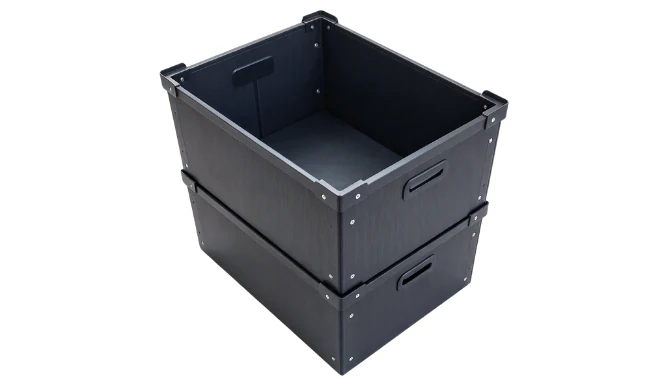
An esd box with dividers needs a mechanical layout and an electrical protection brief. ESD boxes and esd containers are selected for the actual part, handling environment and transport route. Anti static boxes is a broad search term; it does not establish a resistance range or shielding performance.
For esd storage boxes, esd bins and esd totes, identify the surfaces that touch the component and how the container is used in your ESD control process. Conductive boxes and static shielding boxes are not interchangeable terms. ESD divider boxes need the outer box and internal contact materials reviewed together.
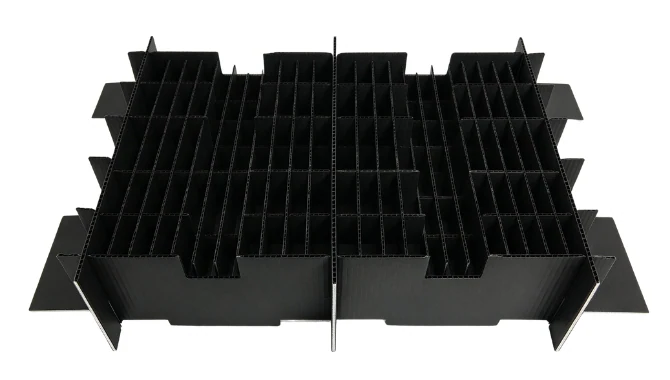
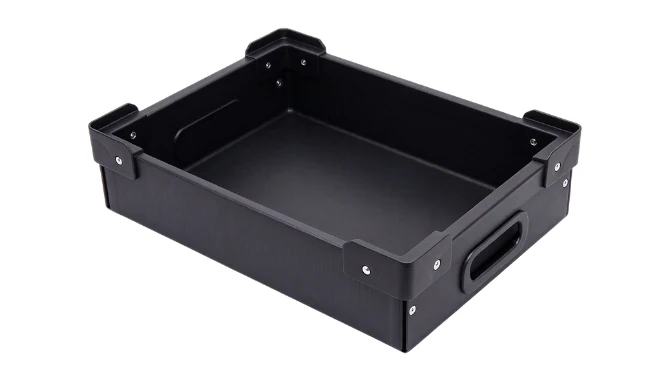
Define cells around the component, finger access and removal direction. Separation supports organized handling without assuming electrical suitability.
Specify box, divider, lid and cushioning materials as a complete assembly. Electrical properties must be confirmed for the proposed materials.
Record drawing, material grade, test evidence and sample revision. Keep changes in inserts or labels visible to the approval process.
| Term | What it addresses | What to request |
|---|---|---|
| Low charging / anti-static | Charge generation during contact and separation | A defined assessment for the intended material contact and use |
| Static dissipative | Controlled electrical resistance for charge dissipation within the handling system | Required range, measurement method, conditioning and sample evidence |
| Conductive | A different resistance classification and path for charge transfer | Grade-specific test evidence and suitability for the part and handling process |
| Discharge shielding | Protection of the contents against external electrostatic discharge | Evidence for the complete enclosure / packaging arrangement, not just a board resistance reading |
ESD storage containers and esd compartment boxes should be reviewed within the customer’s protection plan. The label esd safe boxes does not prove that anti static storage boxes or esd plastic containers satisfy a particular device requirement. Define electrical properties and mechanical fit separately.
Background: EOS/ESD Association control principles distinguish charge-control packaging and shielding for transport outside an ESD protected area (EPA). This reference does not certify a Xingyu product.
| Parameter | Confirm before ordering |
|---|---|
| Structure | Corrugated PP divided-box enquiry; molded and framed alternatives require separate confirmation |
| Dimensions | External size, usable internal size and tolerances from the approved drawing |
| Divider layout | Rows, columns, clear cell size, depth, slot fit and loading direction |
| Electrical requirement | Customer-specified range, method, conditioning and acceptance criteria; no unverified resistance value is claimed |
| Box and insert materials | Confirm the actual outer panel, divider, lid, liner and cushioning grades |
| Lid and closure | Open top or compatible lid enquiry; closed appearance is not shielding evidence |
| Handles and edges | Grip slots, separate handles, reinforced rim or edge finishing per design |
| Load and stacking | Filled mass, supports, stacking duration and sample test agreed per project |
| Marking and traceability | Product identification, material reference, drawing revision and any approved ESD marking |
| MOQ, price and lead time | Written quotation after layout, electrical evidence, quantity and delivery review |
ESD boxes with lids, black conductive boxes and esd shipping boxes need their actual assembled scope defined. A black color, lid or printed ESD symbol alone does not demonstrate the required electrical protection.
ESD box dividers can locate parts in separate cells. Review fit, rigidity and electrical suitability of each contact surface.
ESD divided storage boxes need enough hand access without excessive part movement or exposed sharp edges.
Conductive containers and static dissipative boxes require different electrical specifications. Dissipative storage containers are reviewed against the actual control plan.
ESD stackable containers need a defined rim, lid and load arrangement; stackability is confirmed mechanically.
Mark cells or lots where identification is needed. Label materials and positioning must also suit the ESD process.
ESD turnover boxes should be checked for damage, contamination and the agreed verification routine before reuse.
PCB storage boxes and esd boxes for electronics need slot or cell geometry that avoids sensitive contact points. Identify connector clearance, board orientation and the approved loading method.
SMT component storage boxes and esd component storage boxes should match the packaged part or tray and the handling sequence. Do not infer direct-device contact suitability from a photo.
ESD boxes with compartments, anti static divider boxes and esd storage bins with dividers organize lots. Confirm cell dimensions and the electrical properties of the insert as well as the box.
Semiconductor storage boxes are application enquiries requiring device-specific packaging and any cleanliness qualification. No wafer, cleanroom or moisture-barrier certification is implied.
Anti static bins and esd conductive totes may be considered within a qualified handling process. Confirm transfer points and the required package state.
ESD electronics packaging and static sensitive device packaging need a complete transport review. Ordinary divided totes do not automatically replace a qualified shielding package.
Review die-cut slots, separate handles or a plain wall. Grip features must preserve cell clearance and the agreed material / mechanical arrangement.
Rectangular boxes, shallow trays and trapezoidal concepts require the actual part drawing and workstation footprint. A changed shape can alter cell layout and usable dimensions.
Removable cross-grid, PCB slot cards, one-piece insert or qualified cushioning are separate options. Confirm each insert material and cell tolerance.
Open, separate-lid or attached-lid designs are reviewed individually. A lid may aid containment without creating a verified shielding enclosure.
A rigid box, scored flat-pack body or hinged-wall structure has a different assembly sequence. Verify the effect on joints and the proposed electrical performance.
Conductive polypropylene boxes, esd corrugated boxes and esd pp boxes are material enquiries. Confirm exact grade and evidence rather than assigning a value from the name.
ESD euro containers and esd klt boxes require dimensional and interface confirmation. A standard-shaped box is not automatically a certified KLT or VDA product.
An esd turnover box with dividers or conductive box with dividers should be approved with the intended lid, insert, contents and any separate shielding packaging.
Choose a concept and add it to the enquiry below. Options require design, material and sample confirmation.
| Comparison | ESD divided turnover box | Standard PP divided turnover box |
|---|---|---|
| Primary purpose | Part separation plus the specified electrical protection in a qualified process | Part separation and mechanical handling; no ESD protection is assumed |
| Base polymer | May also be PP, but with a selected electrically controlled formulation / construction | Standard PP formulation, unless another grade is explicitly ordered |
| Electrical evidence | Required range, method, conditioning and material / assembly evidence defined | Ordinary PP designation provides no electrical qualification |
| Dividers and liners | All relevant contact surfaces reviewed for the intended device and control plan | Chosen for mechanical fit, surface contact and handling |
| Color | Often supplied in dark grades, but appearance is not proof of performance | Color is a visual choice; black PP is not automatically conductive |
| Use outside an EPA | Review shielding needs for the complete closed packaging system | Not a substitute for qualified static-sensitive-device packaging |
| Sample approval | Mechanical fit plus the agreed electrical and packaging checks | Mechanical dimensions, handling, load and surface-contact checks |
| Quotation basis | Electrical grade, evidence, inserts, testing scope and mechanical design | Material, dimensions, dividers, finishing and quantity |
The key difference is the specified electrical behavior and its evidence—not simply the fact that the box is made from PP. If the contents are static-sensitive, have the packaging plan reviewed before replacing an ESD assembly with a standard PP box.
Compare General PP Divider Layouts ↗| Alternative | Mechanical selection | Electrical selection |
|---|---|---|
| Standard corrugated PP | Custom-cut box and divider layouts | No ESD performance assumed without a defined grade and evidence |
| Molded ESD plastic container | Fixed or tool-dependent geometry, rim and base | Specify actual grade and complete configuration |
| ESD paperboard packaging | Folded or fitted packaging concepts | Assess coatings / construction, wear and relevant qualification |
| Shielding bag plus tote | Combines a defined inner package with mechanical support | Review bag closure, contact materials and complete transport arrangement |
| Cushioning insert | Fits or protects a component mechanically | Foam type or color alone does not establish electrical suitability |
Identify outer box, divider, lid, liner and drawing revision. List the relevant electrical evidence rather than using an unsupported certification label.
Agree shipment of empty boxes, assembled cells or flat-pack inserts. Protect edges and separate loose fittings to prevent damage.
For esd boxes wholesale and bulk esd boxes, specify quantity, pack arrangement and destination. MOQ and dispatch timing are confirmed in writing.
Compare an esd container manufacturer and esd box suppliers against the same mechanical and electrical brief. Custom esd boxes require agreed sample and verification scope; esd box price depends on grade, layout, inserts, testing requirements, quantity and delivery basis.
Not necessarily. Both may use PP. The actual formulation, electrical properties and qualification evidence distinguish the ESD proposal.
No. Color is not an electrical test. Request the exact material identification and relevant evidence.
No. They address different properties. State the required protection, test method and handling environment before selecting packaging.
No. Review shielding and closure requirements for the complete packaging system. A conductive panel or fitted lid alone does not prove shielding performance.
Yes. Contact materials, divider edges, liners and cushioning are part of the actual packaging arrangement.
No universal value is claimed. Agree the required range, method, conditioning and acceptance criteria, then confirm evidence for the proposed material and assembly.
Provide part dimensions, clearances, rows, columns, depth and loading direction. Approve a representative layout with actual parts.
These are options for review. Confirm fit, structure, materials and whether they are included in the quote.
No certification is implied by these search terms. State the actual dimensional, interface and qualification requirement.
Establish inspection, cleaning and verification requirements for your process. Do not reuse a damaged or unqualified assembly based solely on its appearance.
Suitability requires device-specific contact, cleanliness and packaging qualification. No such blanket approval is stated.
Send the part drawing, internal and cell size, quantity, electrical requirement and method, EPA / shipping route, lid, insert and destination.
Request a representative sample and agree the application-specific acceptance checks before repeat production.
Discuss A Sample Review ↗Use the same dimensions, GSM, quantity and delivery basis when comparing suppliers. We will review production feasibility before confirming price, minimum order, sample cost and lead time.
Send the component drawing, cell layout and required electrical protection. We will review the proposed material, sample scope and written quotation with you.
Discuss My ESD Box Specification ↗